How SWEED Automated I-Joist and Beam Stacking at an LVL Manufacturing Facility
Introduction
Automation continues to reshape engineered wood manufacturing, but introducing new equipment often creates unexpected challenges elsewhere in the production process.
When a Southern Oregon LVL manufacturing facility implemented a beam wrapping and automatic stapling system, it successfully automated part of its packaging process—but also introduced a new downstream bottleneck. SWEED developed its Automated I-Joist and Beam Stacking System to eliminate that bottleneck by automating the stacking operation, reducing stacking man-hours, improving production efficiency, and integrating directly into the customer’s existing production line without requiring major production line modifications.
The Challenge
The customer implemented a beam wrapping and automatic stapling system as part of an effort to automate its packaging process. Prior to installation, completed beam units were stacked using an overhead crane before being transported to storage.
The new wrapping and automatic stapling system changed how completed beam units exited the production line, making overhead crane stacking no longer possible. Instead, beam units were discharged one at a time, requiring a forklift operator to manually build four-high stacks before transporting them to storage.
SWEED’s Solution
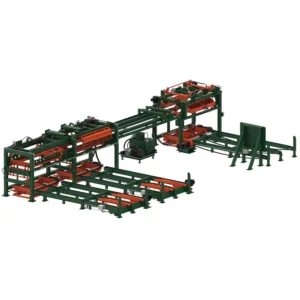
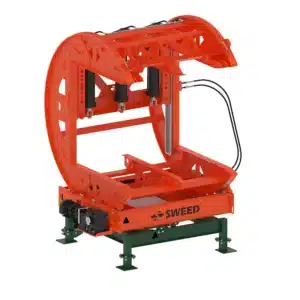
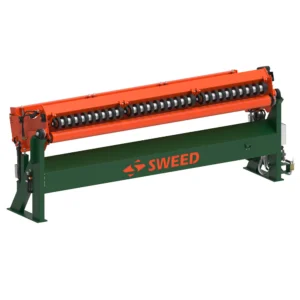
To eliminate this bottleneck, SWEED engineered the Automated I-Joist and Beam Stacking System to integrate directly into the customer’s existing production line downstream of the automatic stapling system.
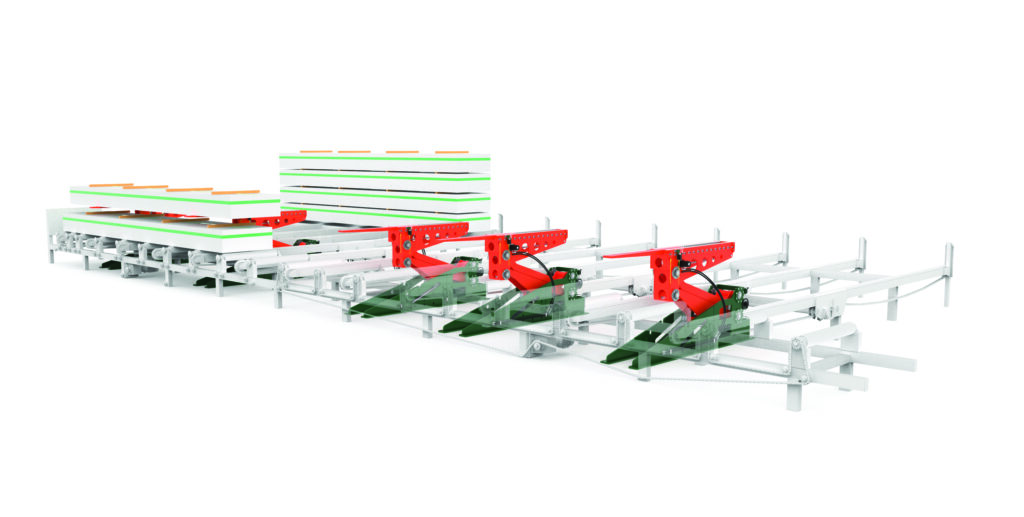
As each unit exits the conveying system, the system automatically builds uniform four-high stacks for products ranging from 20 to 66 feet in length.
Once complete, the finished stack is picked up by a forklift and transported directly to storage.
Because the system integrates directly into the customer’s existing production line, it adds automated stacking without expanding the production footprint or requiring significant production line modifications.
Results
By automating the stacking process, the customer eliminated one forklift and one forklift operator from the stacking operation while reducing stacking man-hours, material handling time, fuel consumption, and equipment wear. Operator safety also improved by removing operator involvement in stacking beam units.
Implementation of the system:
- Eliminated one forklift and one forklift operator from the stacking operation.
- Reduced stacking man-hours and material handling time.
- Reduced fuel consumption and equipment wear.
- Improved operator safety by removing operator involvement in stacking beam units.
- Produced consistent, uniform four-high stacks ready for storage.
Why It Matters
Manufacturers often focus on automating individual production processes, but new automation can introduce unexpected bottlenecks elsewhere in the production line.
After the customer’s new wrapping and automatic stapling system changed how beam units exited the production line, manual forklift stacking became the new constraint.
Without requiring major changes to the customer’s existing production line, SWEED engineered an automated stacking solution that integrated directly into the existing system and eliminated that downstream bottleneck.
The result is a practical automation solution that improves production flow, reduces labor dependency, enhances operator safety, and helps manufacturers maximize the return on their automation investment.